

Build → Assistant → Select Assistant → Tools
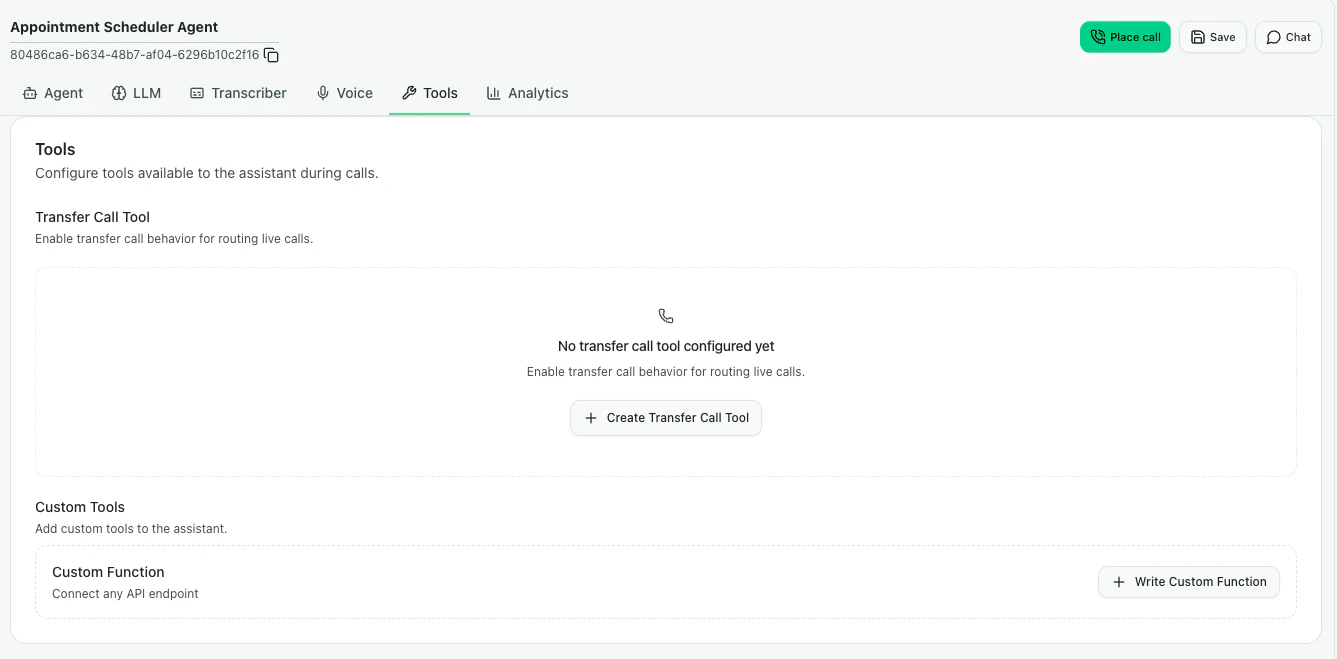
Tools tab in CallHQ assistant setup
Function calling follows the OpenAI function calling specification, so you can reuse compatible function schemas with CallHQ.
What is Function Calling?
Function calling gives your assistant access to tools that run when the conversation requires an action. For example, a support assistant can transfer a caller to a human agent, while a scheduling assistant can collect appointment details and send them to your booking system. The assistant decides when to call a function based on the conversation context, the function name, and the function description you provide.Available Function Tools
CallHQ provides function tools for common voice AI workflows. Use the Tools section in the assistant setup to add and configure tools for your assistant.Transfer Call
Route a live call to a human agent or another phone number.
Custom Function
Connect your assistant to an external API endpoint using a custom function schema.
How It Works
1
LLM Reads Function Definition
The LLM reads the function’s
name, description, and parameters to understand what the function does.2
Assistant Decides When to Call
Based on the live conversation, the assistant decides whether the function should be triggered.
3
Assistant Extracts Parameters
The assistant collects the required parameter values from the caller’s responses.
4
CallHQ Executes the Request
CallHQ sends the configured request to your API or runs the selected built-in tool.
5
Response Returns to the Assistant
The function response is passed back to the assistant so it can continue the conversation naturally.
Context Variables
You can pass conversation context into function parameters using variables. These values are automatically available during calls:Variables defined for your assistant are automatically substituted in function parameters. Learn more in Variable Values.
Best Practices
- Write clear function names that describe the action, such as
book_appointmentortransfer_to_support. - Use detailed descriptions that explain when the assistant should call the function.
- Mark only truly required fields as required, so the assistant does not over-collect information.
- Test function behavior with chat, web calls, and phone calls before using it in production.
- Keep API responses concise so the assistant can easily interpret the result.